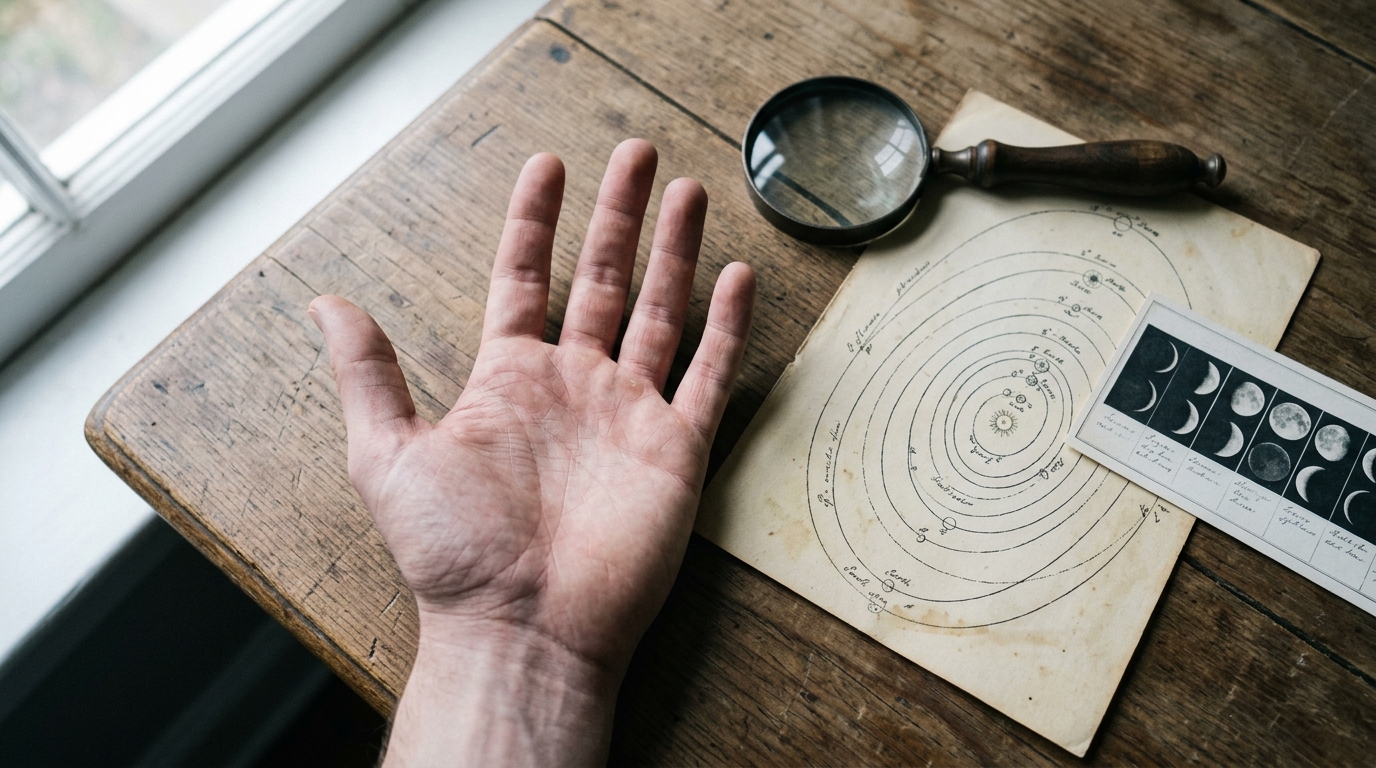
The question hiding inside 'is palm reading accurate'
Type "is palm reading accurate" into Google and you'll get a shrug dressed up as an answer: some pages say it's bunk, some say it's ancient wisdom, most just quote both sides and leave. That's not an answer, it's a stall.
The real question splits into two very different ones. First: does palmistry make testable predictions about your future the way a medical test or a weather forecast does? No — and we'll show exactly why, using a specific line, not a vague gesture at "palmistry." Second: does an interpretive tradition applied consistently tell you something meaningful about how a reader sees personality and patterns? That's a different, more defensible claim.
This article keeps those two questions separate the whole way through, including where palmistry's interpretation sits next to actual astronomy vs astrological interpretation — because moon phases are computed fact, and what a reading does with them is something else entirely.
Myth: palmistry makes testable predictions about your future
The most persistent claim in palm reading is that the life line — the crease curving around the base of the thumb — tells you how long you'll live. It's the line most people ask about first, and it's also the one most directly tested.
The Atlantic's coverage notes that palm readers have claimed predictive power over the future for thousands of years, which is exactly the kind of claim that can, in principle, be checked. So it was checked. A study cataloged in Flinders University's research repository, Predicting longevity from the line of life: Is it accurate?, examined whether the length or depth of the life line actually correlates with how long someone lives. It doesn't hold up as a predictive tool — the line's physical traits don't track lifespan in a way that would let anyone use it diagnostically.
That's the myth, specifically: not "palmistry is fake" in general, but "the life line predicts longevity" in particular, and that particular claim has been tested and doesn't survive contact with data. Palm creases form largely before birth and shift with age, injury, and hand use — mechanical facts about skin, not a countdown clock. If a reader tells you your life line reveals how many years you have left, that's a claim with no scientific reference behind it, stated as if it were established. Treat it as tradition-based interpretation, not diagnosis, because that's what the evidence supports it being.
What palmistry actually is: a symbolic interpretive tradition
Strip out the longevity myth and what's left is not nothing — it's a framework. HowStuffWorks' explainer on palm reading lines describes palmistry, or chiromancy, as an ancient practice examined here specifically as myth versus science, and that framing is the right one: it's a symbolic system, like tarot or a personality typology, not a measuring instrument.
Inside that system, the heart line is read as tracking emotional expression and relationship patterns, the head line as tracking thinking style and decision-making, and the life line — despite the longevity myth — as tracking vitality and major life changes in a symbolic sense, not a medical one. None of these are backed by a mechanism connecting skin crease geometry to personality or fate. There's no tissue, nerve, or genetic pathway that would make a line on your palm reflect who you are as a person, and no study has established one. What exists instead is centuries of accumulated convention: readers agreeing, generation to generation, on what a given line or mount is supposed to represent.
That's worth taking seriously on its own terms — the way you'd take a tradition of symbolic interpretation seriously — without dressing it up as something it isn't. A palm reading can be a structured way to reflect on personality and patterns. It is not a forecast, and any page that treats the two as the same thing is skipping the part that actually matters.
What IS exact: the astronomy behind moon phases and retrogrades
Here's the distinction most sites blur, and it's the one this article is built around: some of what shows up next to palmistry and astrology is not interpretation at all — it's computed astronomical fact.
A moon phase is not a belief. Whether the moon is full, new, waxing, or waning on a given date is a matter of orbital mechanics — the moon's position relative to the sun and Earth — calculable years in advance with no ambiguity. Same with a retrograde: when astrology apps say Mercury is "in retrograde," they're describing a real, observable phenomenon — the planet appears to move backward against the background stars from Earth's vantage point, because of the relative speeds of the two orbits. That apparent motion is measurable and predictable. Nobody debates whether it's happening.
What's not computed fact is what any of that is supposed to mean for your week, your relationships, or your mood. That leap — from "Mercury appears to move backward" to "expect communication breakdowns" — is pure interpretation, carried by astrological tradition, not by physics. The retrograde is real. The meaning assigned to it is a story layered on top.
Palmistry works the same way structurally, even without the orbital mechanics: the shape of your hand and the depth of a crease are physical facts you can photograph and measure. What a given line is said to represent is the interpretive layer. Keeping those two layers labeled — fact here, tradition there — is the whole difference between an honest reading and an oversold one.
Why consistency beats accuracy — the same mapping method, every time
If palmistry can't be validated as predictive, what's actually being offered when a reading feels right? Usually, it's consistency, not accuracy — and those are different claims that get collapsed into one all the time.
Accuracy would mean: this line reliably corresponds to a real-world outcome, verified against data. Palmistry doesn't clear that bar, as the life-line research above shows. Consistency means something narrower and more honest: a reader applies the same mapping — this mount means this, this line depth means that — every time, to every hand, using the same reference system. That's a claim about method, not about truth. A tarot deck is consistent in that sense too: the Tower card means upheaval every time you draw it, which doesn't make upheaval a scientifically detectable event.
This is also where the "is palm reading more accurate than astrology" comparison actually resolves. Astrology has one piece of hard ground — the computed positions of planets and moon phases — and then builds an entire interpretive structure on top of that real astronomy. Palmistry has its own hard ground — the actual, photographable shape of a hand — and builds a comparably old interpretive structure on top of that. Neither tradition is more "accurate" than the other in a scientific sense, because neither is making a claim science can currently validate. What differs is just which real, observable thing sits underneath the story.
A Quora thread on palm reading accuracy reflects this directly: contributors there report that palmistry isn't 100% accurate largely because there's no research base establishing it as such — a skeptical view worth naming plainly rather than smoothing over.
How to spot a reading that's overselling
Consistency is a fair thing to expect from a reading. Certainty is not. Here's what tips a reading from tradition into overselling:
- It predicts a specific date or event. "You'll get married in the next 18 months" is not something any line has been shown to encode. Tradition-based interpretation talks in tendencies and patterns, not calendar entries.
- It claims scientific validation. Phrases like "proven by research" or "medically confirmed" should be a stop sign — no independent scientific body has validated palmistry's predictive claims, and a reading that says otherwise is misrepresenting its own evidence base.
- It never distinguishes fact from interpretation. A reading that talks about a moon phase or a palm crease as if both carry the same evidentiary weight is blurring exactly the line this article draws.
- It uses only flattering, universally-applicable statements. Broad, positive-sounding claims that could apply to almost anyone are a known feature of cold reading and the Barnum effect, not a sign of a sharp, specific read.
- It won't say what it doesn't know. A reader who never says "there's no research behind this specific claim" is skipping the caveat a careful tradition owes you.
A reading built on the brand's stated approach names the line, states the tradition behind the interpretation, and separates that from anything that's actually measurable — rather than letting the two blur into one confident-sounding paragraph.
So is it worth trying? A fair verdict
Is there any truth in palm reading? Here's the direct answer: not in the sense of scientifically verified prediction — no study supports palm lines forecasting specific future events, and the life-line-longevity research is a clear example of a testable claim that didn't hold up. But yes, in the sense that a structured, consistently-applied symbolic tradition can offer a genuinely useful mirror for thinking about personality patterns, the same way a well-run personality framework or a tarot spread can, without either one being a scientific instrument.
So: is palm reading accurate? No, not as a predictive science — that's a settled point, not an open debate. Is it worthless? Also no. Treat it the way you'd treat a good conversation with someone trained in a specific interpretive framework: useful for reflection, clear about its own limits, worthless the moment it claims lab-grade certainty.
If you want to see that distinction applied to an actual hand rather than argued about in the abstract, you can try a photo-based palm reading and judge for yourself and see whether the specific-line, labeled-interpretation approach holds up against your own skepticism. For more on how hand shape factors into this tradition, see Your Hand Shape Says More Than Any Single Line on Your Palm, and for a look at what generic AI tools get wrong when they try this cold, I Asked ChatGPT to Read My Palm. It Gave Me a Wikipedia Paragraph. is worth reading next.