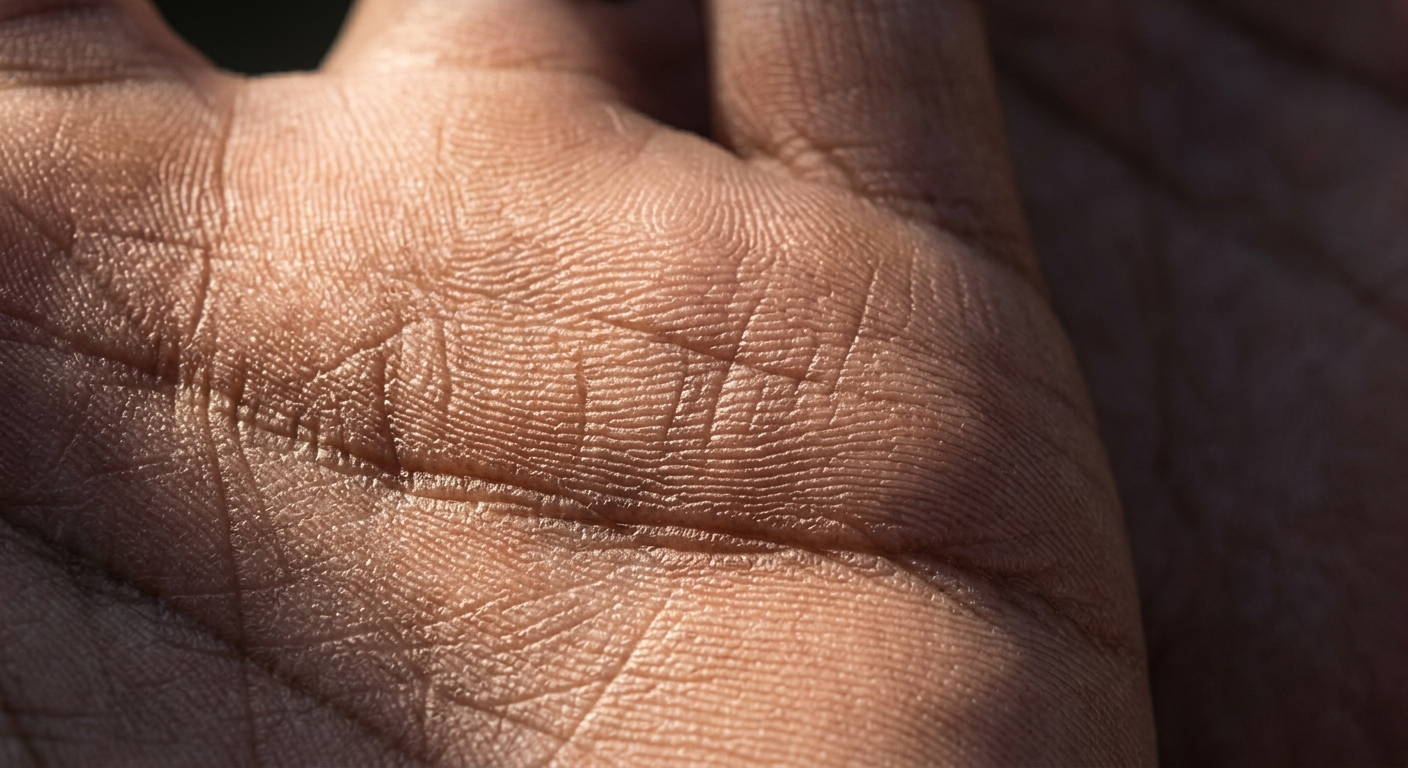
Where the marriage line actually is (most people look in the wrong spot)
Most people go looking for the marriage line right in the middle of the palm, near the heart line's main sweep, expecting something dramatic. It isn't there. The marriage line sits on the outer edge of the palm, on the Mount of Mercury, in the narrow strip of skin between the base of the little finger and the heart line itself. It's usually short — sometimes less than half an inch — and horizontal, running roughly parallel to the finger creases above it rather than curving with the heart line below it.
An academic survey of palmistry symbolism describes it the same way: the marriage line as a small line on the palm's edge, just above the heart line and below the base of the little finger. That's a useful independent check on placement, though the paper is describing tradition, not testing it — nobody has run a controlled study proving this line correlates with anything measurable about a person's relationships.
If you're scanning your own hand right now: look at the pinky-side edge of your palm, right where it meets your hand's outer border, in the sliver of skin above your heart line. If you see one or more short horizontal marks there, that's what palmistry calls the marriage line — sometimes also labeled the relationship line, which is honestly the more accurate name.
What the marriage line traditionally represents
Here's the correction worth screenshotting: the marriage line does not count your marriages. It never did, and no serious palmistry tradition ever claimed it worked that way — that idea is a pop-culture flattening of something more abstract. What the line traditionally represents is your capacity for emotional bonding and your general approach to committed partnership, not a tally of trips to the altar.
This is tradition-based interpretation, not fact — there's no mechanism by which a crease on your palm could register a legal or social event that happens later in life. Palm lines form from repeated hand movement and skin structure, not from future weddings. What readers have historically used the marriage line for is softer: does this person bond quickly or slowly, do they tend toward one deep attachment or several lighter ones, do they lean independent or partnership-oriented by temperament.
One Reddit thread on relationship lines put it bluntly, describing marriage lines as sitting "above the heart line on the side of the mount of Mercury" and calling them "very fickle and unreliable" — that's a reader's own assessment, not a verified claim, but it lines up with how cautiously even practicing palmists treat this particular mark. Compared to the heart line's long, consistent presence in every serious mapping of the palm, the marriage line has always been the tradition's shakiest bet.
Deep, faint, forked, or chained: how readers interpret the variations
If you found your marriage line, the next question is what shape it's in — and every variation below is symbolic interpretation passed down through palmistry tradition, not a scientific classification.
One deep line vs. several faint ones
A single, clearly etched line is traditionally read as one significant emotional bond or a personality suited to one deep partnership at a time. Multiple lines, faint or deep, are read as several meaningful attachments over a lifetime — not multiple marriages, just multiple bonds worth noting. A deep, well-defined line suggests (in this tradition) a strong, stable emotional connection; a faint or shallow one suggests a lighter touch — less intensity in how attachment gets expressed, not necessarily less capacity for it.
Forks and downward curves
A forked marriage line is one of the more dramatic-sounding marks, and traditional readers interpret it as conflicting priorities within a relationship, or a major shift such as a separation. A line that curves downward toward the heart line is sometimes read as emotional strain or disappointment bleeding into how someone approaches closeness. None of this is predictive. A fork on your palm doesn't forecast a breakup any more than a short line forecasts loneliness — palmistry works symbolically, describing tendencies and patterns, not scheduling future events. Treat every reading in this section as a lens, not a verdict.
Why the marriage line is the most over-read line on the palm
The marriage line gets outsized attention for a mark that's genuinely small, genuinely short, and genuinely inconsistent even within palmistry's own tradition. Part of the problem is the name — call something a "marriage line" and people will scan it for wedding dates. But the deeper issue is that this line is short, faint on many hands, and highly sensitive to hand position when read, which makes it one of the least stable marks to interpret consistently even reader to reader.
Compare that to lines that get far less hype but carry more structural weight. If you're wondering what the rarest line in palmistry actually is, most traditions point to the simian line — where the head line and heart line merge into a single crease straight across the palm, instead of running as two separate lines. It shows up on a small minority of hands and gets treated as a genuinely notable variation precisely because it's rare and structurally distinct. The marriage line, by contrast, is common, short, and reads differently depending on how you flex your hand — which is exactly why it deserves far less confidence than pop culture gives it.
The line that says more about your relationships than this one
If you want a line that actually tracks how you handle closeness, look at the heart line instead — the long curved line running horizontally across the upper palm, below the fingers. Where the marriage line is short, faint on many hands, and shifts with hand position, the heart line is long, present on essentially every palm, and stable enough that palmists across different schools of thought largely agree on where it sits and what it maps.
Traditionally, the heart line's depth, length, and curve are read for how someone expresses affection, sets emotional boundaries, and recovers from disappointment — the actual mechanics of a relationship, not a single symbolic mark near the pinky. A deep, unbroken heart line reading suggests steady emotional expression; a heart line that curves up toward the fingers is read differently than one that runs flatter toward the edge of the palm. This is still interpretation, not proof — but it's interpretation built on a line with far more surface area and far more consistency to read from.
If you've been putting weight on your marriage line, that weight belongs on your heart line instead. You can see what your heart line says about your relationships and get the more substantial read most palms actually support.
Reading yours: what to look for tonight
Start with your dominant hand — the one you write with — since most working palmists read the dominant hand for current tendencies and the non-dominant hand for inherited or earlier-life patterns. That's not a hedge; it's the standard practical split, and it applies here the same way it applies to every other line on the palm.
Hold your hand palm-up under a decent light and find the outer edge below your little finger. Look for short horizontal marks in the strip above your heart line — that's your marriage line, or lines, if you have more than one. Note whether it's a single deep line, several faint ones, or something forked. Then look up and follow your heart line all the way across the upper palm — longer, more continuous, and far more telling, according to the same tradition that gave the marriage line its outsized reputation.
If any of this stirs up more questions than answers, that's normal — palmistry was never built to be read in isolation. Your hand shape and mounts shape how every line on your palm should be weighted, and if you've ever wondered whether any of this holds up, the accuracy question is worth sitting with honestly before you take any single line — marriage or otherwise — too literally.